
Start here: one short reading, one question
Hobbes makes protection central to political obligation, while leaving difficult questions about liberty.
Question: When a state cannot protect its people, what happens to their obligation to obey?
Short reading: Read just the opening three paragraphs of Leviathan, chapter XVII, “Of the Causes, Generation, and Definition of a Common-wealth”. Ask why agreement alone is insufficient.
A few sentences are enough to begin. Offer one reason or example, or ask a question about the reading. Add your response below; the longer readings and recordings are optional.
Does political authority earn obedience by protecting us, or does Hobbes ask us to surrender too much liberty in order to escape fear and faction?
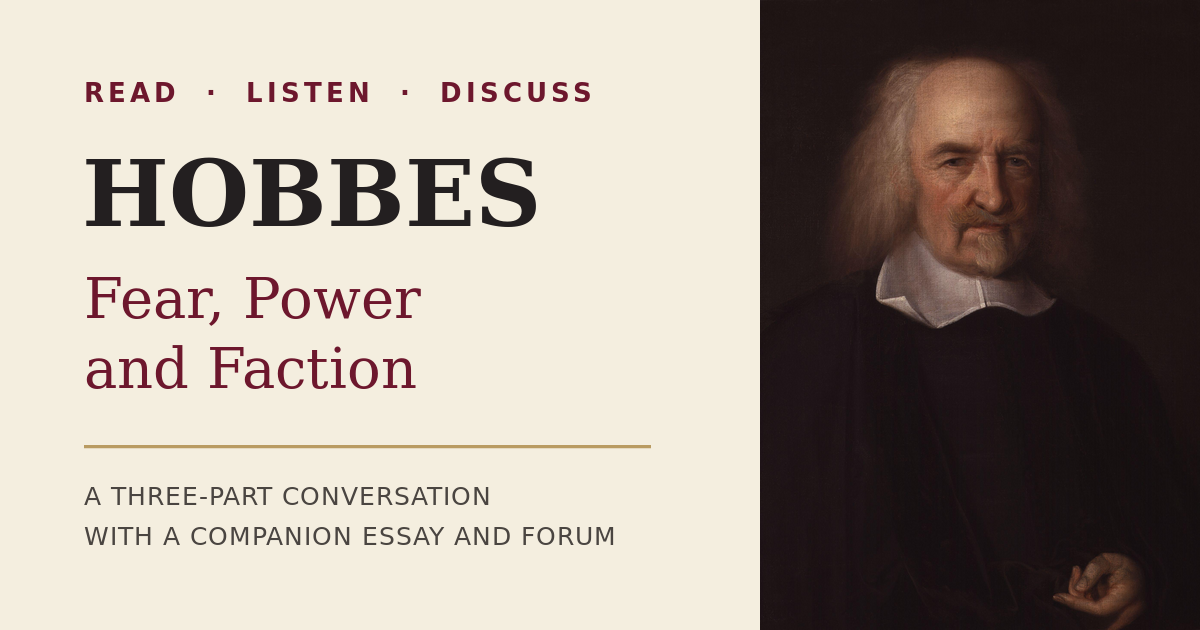
All three episodes are now available. This discussion accompanies the complete three-part Beyond the Text series Hobbes: Fear, Power and Faction. Across the trilogy, Samuel Woodall and Jack Thomson examine how fear shaped Hobbes’s political philosophy, why he believed peace required an effective sovereign, and when disagreement becomes faction.
Watch or listen to the complete series
- Who Was Thomas Hobbes, and What Was He Afraid Of?
- Why Should We Obey the State?
- When Does Disagreement Become Faction?
You can also begin with the series introduction and companion reading at The Intellectual Historian.
Questions for discussion
- Is fear a legitimate foundation for political authority?
- Does Hobbes distinguish convincingly between liberty and the absence of government?
- Why should a covenant authorise a sovereign with such extensive powers?
- At what point does disagreement become faction or sedition?
- Can a stable political community preserve organised opposition without returning to divided sovereignty?
- Does the sovereign’s duty to protect create a genuine limit on obedience?
Join the conversation
You do not need to answer every question. Choose the point that interests you most, respond to another reader, or suggest a passage from Leviathan or De Cive that changes how the problem should be understood.
Read alongside the trilogy
Episode 1: John Aubrey, “Thomas Hobbes of Malmesbury,” Brief Lives, alongside Hobbes’s preface to De Cive.
Episode 2: Hobbes, Leviathan, Part I, chapters 13–14, and Part II, chapters 17 and 21.
Episode 3: Hobbes, De Cive, chapter 12, especially sections 1, 8 and 11–13.
Leave a Reply